

Quick answer: As screen fatigue intensifies, more people are turning to hands-on creative practices like drawing, painting, and collage to restore focus, reduce stress, and reconnect with a sense of agency over their time. You don’t need formal training, just a place to begin.
Why are more people stepping away from screens?
Opus Art Supplies stores are shaped by a wide creative community. Professional artists, students, hobbyists, families, and those who wouldn’t yet call themselves creative all move through the space in different ways. Some come with a specific material in mind, others just to look, or to begin again. And while the questions vary, recently many conversations have begun the same way: I haven’t made anything in years, or I’m trying to get off my phone, or simply, I don’t know where to start.
Staff are noticing a pattern. Not a sudden surge, but a steady shift. People aren’t necessarily arriving with artistic ambitions. More often, they are looking for a way to reset their attention.
‘There’s definitely been more of that,’ says one team member. ‘People coming in for a creative outlet, or something to do away from screens. Especially families trying to find something they can do together.’
What’s striking is not just the volume, but the tone. These are not customers looking to master a technique or invest in a long-term practice. They are looking for something immediate, tactile, and absorbing. Something that holds their focus in a different way.
After years of living through devices, scrolling, responding, absorbing, that desire is becoming increasingly widespread. The appeal of making something, however small, lies partly in its limits. A page. A surface. A finite set of materials. An experience that unfolds at human speed.

What does the research say about creativity and wellbeing?
The renewed interest in creative practice aligns with a broader body of research around attention, stress, and adult play.
In The Artist’s Way, Julia Cameron reframes creativity as a practice rather than a talent. Something that can be reactivated at any stage of life. Similarly, Finding Your Unicorn Space by Eve Rodsky points to the importance of dedicated creative time in maintaining a sense of identity beyond work and obligation.
More recent studies have linked hands-on creative activity with reduced stress, improved mood, and increased cognitive flexibility. The mechanisms are relatively simple: sustained attention. sensory engagement, a clear beginning and end point — conditions that are increasingly rare in digital environments.
Do you need to be creative to start?
The idea that creativity belongs to a select few remains one of the biggest barriers to entry. In reality, research consistently suggests the opposite. Creativity is a universal human capacity, not a specialised talent. Studies in psychology and neuroscience, including work on everyday creativity and divergent thinking, show that the ability to generate ideas, make connections, and imagine alternatives is something we all possess, even if it goes underused.
In practice, most people already have a point of reference. ‘A sketchbook and a pencil set is always a great place to start,’ says Vancouver Downtown Store Coordinator Eri Irimagawa. ‘We’ve all doodled in the margins at school, or on the phone.’
What tends to change in adulthood is not capacity, but permission.
There is often an expectation that creative work should be purposeful or accomplished. Without that, it can feel easier not to begin at all. But the current shift suggests a different approach. One that prioritises process over outcome, and consistency over skill. Or, more simply: starting is the work.
What kinds of creative practices are people returning to?
The entry points are varied, but they tend to share certain characteristics: accessibility, tactility and room for experimentation.
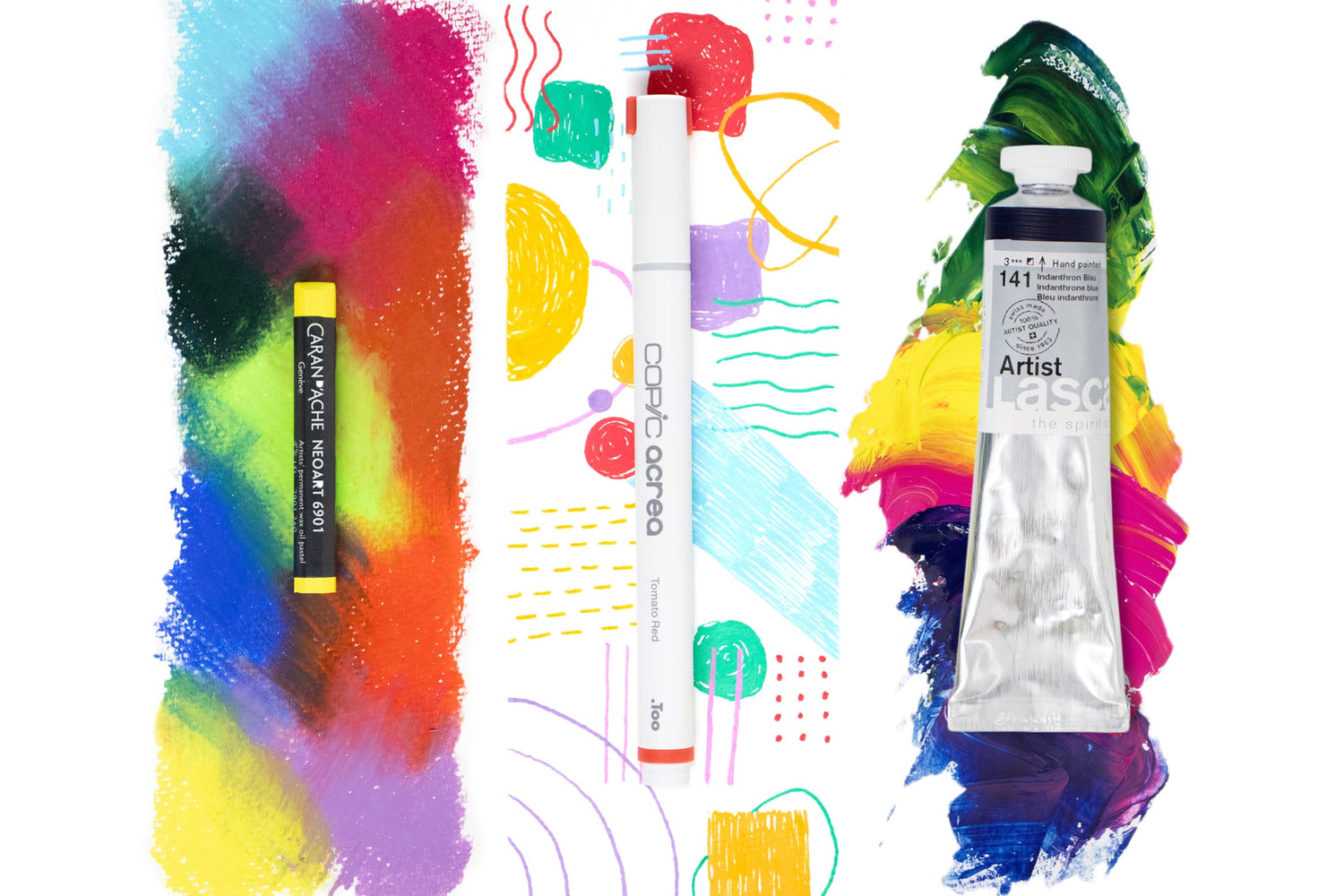
Drawing remains the most common, inexpensive, familiar, portable. Watercolour and other water-based media are also popular, offering a balance between structure and unpredictability. Markers, oil pastels, and collage introduce colour and texture without requiring technical precision.
There has also been an increase in interest in process-led kits — tie-dye, marbling, cyanotype — particularly among families. ‘They’re looking for something engaging, something hands-on,’ one staff member notes. ‘It’s less about the end result, more about the experience of doing it.’
Materials that allow for variation tend to hold attention longer: water soluble pencils, brush pens and layered media. They offer multiple outcomes from a single starting point, which encourages continued use.
What do people typically buy first?
The most consistent answer is also the simplest. A sketchbook.
It is a low commitment entry point, but also a psychologically important one. A contained space, with no expectations attached.
From there, purchases tend to diverge. Some people stay with drawing. Pencils, fineliners. Others move quickly toward colour. Watercolour sets, brush pens, water soluble crayons.
‘There are people who go straight for a watercolour set and a book for painting outside,’ says Kelowna Store Manager Katie Poetsch. ‘Others stick with sketching. It really depends on what feels engaging.’
That sense of engagement is key. The materials themselves do not need to be sophisticated, they need to be inviting.
What helps people sustain a creative practice?
Starting may be the hardest step, but continuing presents its own challenges.
Momentum tends to come from either novelty or rediscovery. Trying a new medium, particularly one that is tactile or unfamiliar, can reintroduce a sense of play. Oil pastels, for example, offer immediate, physical feedback that differs from more controlled media.
Equally, returning to previous work can be unexpectedly generative. ‘Flipping back through old sketchbooks can spark new ideas,’ says Katie. ‘There are often things you were excited about that you never followed through on.’
What emerges from both approaches is a shift away from linear progress. Creative practice becomes less about improvement, and more about maintaining a relationship with the process itself.
How can you tap into creativity, without overhauling your life?
If the impulse to make something is there, the next question is often practical. How do you actually begin, and sustain it?
Guidance from programs like the University of Victoria’s Continuing Studies points to a handful of simple, repeatable approaches. None of them require significant time or expertise. But they do require a shift in how creativity is framed.
Start small, and make it regular.
Creative practice is less about intensity than consistency. A few minutes of sketching, mark-making, or colour mixing is often enough to build momentum.
Lower the stakes.
Removing the expectation of producing something good can make it easier to begin. Loose constraints, filling a page, limiting materials, help bypass hesitation.
Follow curiosity rather than outcome.
A colour. A texture. A shape. Materials that respond, water-based media, pastels, layered pens, support open-ended exploration.
Change your environment.
Working outside, shifting location, or adjusting the time of day can alter how ideas emerge and sustain attention.
Reconnect with what you already have.
Returning to an old sketchbook or unfinished idea can often be enough to restart the process.
Taken together, these approaches suggest that creativity is not something you wait for, it is something you create the conditions for.
FAQ
I’m not creative. Is this still relevant to me?
Yes. Creativity is a practice, not an inherent trait. Most people already have the foundational skills. They have simply gone unused.
What are the easiest creative hobbies to start?
Drawing, watercolour, and marker-based work are among the most accessible in terms of cost, setup, and learning curve.
Can creative hobbies actually help reduce screen time?
They provide a slower, more focused alternative to passive consumption, naturally shifting attention away from devices.
What do I need to get started?
At minimum, a sketchbook and a drawing tool. Additional materials can be introduced gradually, based on interest.