


Lightfast & Luminous: Discovering 12 New Opus Essential Oil Colours with Tiffany Blaise
Through the stroke of her brush, contemporary landscape painter Tiffany Blaise explores the atmospheric and emotive essence of coastal landscapes. Working in thin veils of colour, she builds luminosity gradually, allowing underlayers to shimmer through before finishing with impasto passages of oil paint mixed with cold wax to accentuate the shifting textures of water and trees. Her paintings evoke not just a place, but the sensation of standing within it.
In anticipation of her upcoming in-store demos, we invited Tiffany to work with the 12 new additions to our Opus Essential Oil Colours range, curious to see how these hues might settle into her coastal palette.
First Impressions: Handling and Pigment Load

From the first squeeze of paint, the response was tactile and immediate. Smooth and buttery, yet balanced and responsive, the colours held their body without feeling stiff. 'Their consistency felt just right,' Tiffany explains. 'I was really impressed by the pigment load of each colour and how nicely it translated on the canvas when applied with a variety of tools, including palette knives and brushes.'
For an artist whose practice depends on transparency and depth, handling is everything. 'Although I'd be happy to use these straight from the tube, I almost always add Liquin or mineral spirits to extend them,' she says. 'I like to paint with light layers to achieve a delicate sense of luminosity, created by underlayers shining through.' Whether worked into transparent glazes or built up into textured impasto, the paints proved adaptable, capable of holding both softness and structure within the same piece.
What's New in the Opus Essential Oil Colours Range


There is something quietly transformative about a refreshed palette. The shift of a yellow, the depth of a new red, the glow of a balanced green. These small adjustments can change how a painting begins.
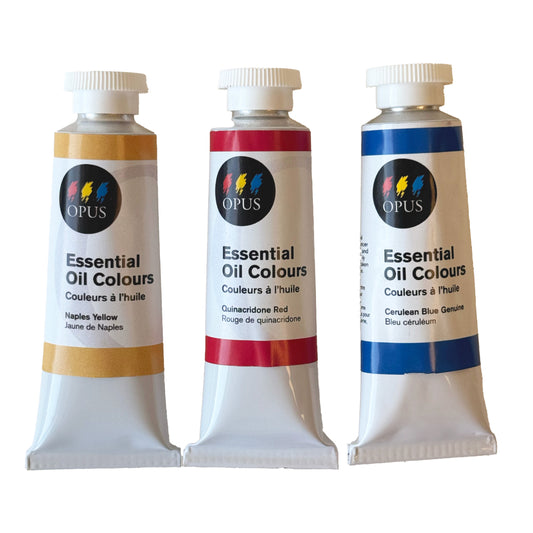
With 12 new lightfast additions, the Opus Essential Oil range has been thoughtfully expanded to reflect how artists are working today. The result is a broader, more nuanced spectrum that includes luminous yellows, expressive reds, earthy transparents, and an exclusive Aquamarine available only at Opus.
Expanding both range and mixing potential, these hues integrate seamlessly into the existing line while offering fresh temperature variation and greater tonal depth across the palette. For painters who rely on shifts in atmosphere across sky, water, or foliage, that expanded range makes a tangible difference in practice.
Tiffany's Standout Colours for Coastal Painting

Tiffany felt this immediately. While she reached instinctively for many of the new colours, a few quickly became standouts.
Aquamarine established itself as a new anchor in her coastal scenes. Mixed with Titanium White and a touch of Cadmium Yellow Light, it became the pale aqua-white of a cresting swell, that fleeting moment when light caught the water just before it broke. 'It's great for painting the lighter sections of an ocean wave,' Tiffany explained, noting how easily it shifted from saturated sea tones to airy highlights with only subtle adjustments on the palette.
While Aquamarine moored her seascapes, Rose Madder Quinacridone and Mixing Gold expanded the emotional temperature of her palette. Together, they captured the glow of golden hour: backlit clouds edged in pink, sunlit sand holding onto the last trace of daylight. Rather than overpowering a scene, these hues radiated from within, offering richness without muddiness.
Then there was Cinnabar Green Medium, a colour that gently nudged her outside her comfort zone. 'I don't normally use green straight from the tube,' she admitted, but curiosity led her to experiment. Mixed with Cadmium Yellow Light and softened with Mixing Gold, it became the flicker of sunlight catching the edges of trees, a subtle yet transformative shift in her landscape vocabulary.
Tiffany's Top 5 Recommended Colours to Start With